
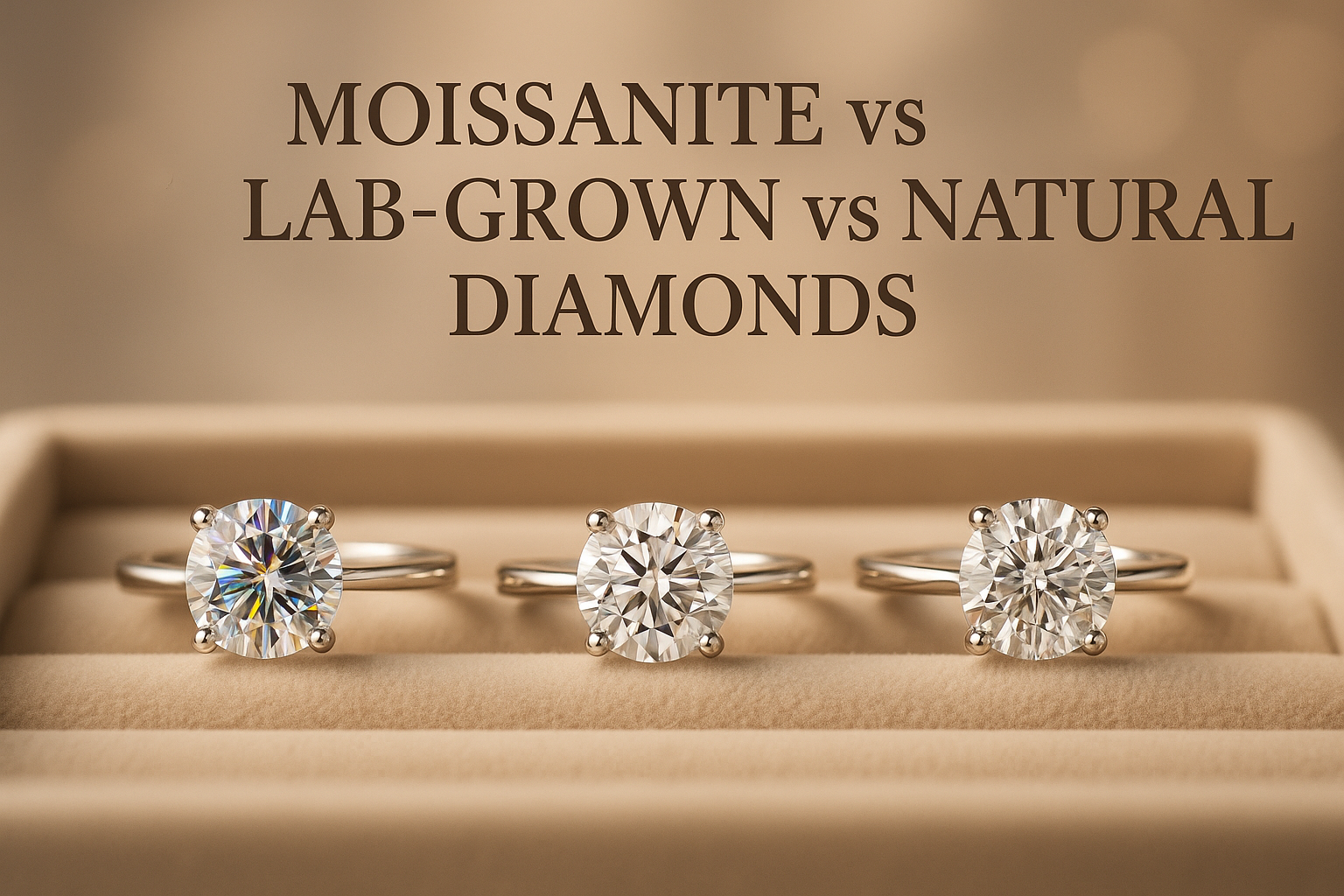
Moissanite vs Lab-Grown vs Natural Diamonds: Which Ring Should You Buy?
Introduction
Shopping for an engagement ring in the U.S. today can feel overwhelming. In addition to the traditional natural diamond, two strong alternatives have gained popularity in recent years: lab-grown diamonds and moissanite.
Each of these stones has its strengths. Natural diamonds carry tradition, rarity, and resale value. Lab-grown diamonds deliver the same sparkle at a fraction of the cost. Moissanite, meanwhile, is a budget-friendly, brilliant option that appeals to couples looking for something unique.
So which should you choose for your engagement ring? This guide breaks down everything American buyers need to know about moissanite vs lab-grown vs natural diamonds—covering durability, appearance, cost, ethics, and resale—so you can make a confident, informed decision.
What is Moissanite?
Moissanite is a naturally occurring mineral discovered in 1893 by French scientist Henri Moissan in a meteor crater. Because natural moissanite is extremely rare, nearly all moissanite used in jewelry today is lab-created.
- Composition: Moissanite is made of silicon carbide (SiC).
- Appearance: Known for its incredible fire—moissanite disperses light differently than diamonds, often creating colorful rainbow flashes.
- Durability: With a 9.25 rating on the Mohs hardness scale, moissanite is highly durable, though slightly softer than diamond.
- Price: Significantly less expensive than diamonds. A 1-carat moissanite can cost between $500–$1,000, compared to thousands for a diamond.
Moissanite has carved out its niche as a diamond alternative, especially for buyers who prioritize affordability and unique sparkle.
What Are Lab-Grown Diamonds?
Lab-grown diamonds are real diamonds—not imitations. They are chemically, optically, and physically identical to mined diamonds, created in controlled lab environments.
- Composition: Pure carbon, identical to natural diamonds.
- Production methods:
- CVD (Chemical Vapor Deposition) — builds the diamond layer by layer.
- HPHT (High Pressure High Temperature) — mimics the Earth’s natural formation process.
- Appearance: Visually indistinguishable from mined diamonds to the naked eye.
- Durability: 10 on the Mohs scale, the same as natural diamonds.
- Price: Typically 60–90% less expensive than natural diamonds of comparable grade.
With lower costs and the same sparkle, lab-grown diamonds have surged in U.S. popularity, especially among Millennials and Gen Z couples.
What Are Natural Diamonds?
Natural diamonds remain the classic benchmark for engagement rings.
- Formation: Created 1–3 billion years ago deep within the Earth under extreme pressure and heat.
- Uniqueness: Every natural diamond is one-of-a-kind, valued for rarity and tradition.
- Hardness: 10 on the Mohs scale—the hardest known material.
- Price: Highest of all three options, reflecting rarity and mining costs.
- Resale: Retains the best resale and trade-in value.
For many, natural diamonds symbolize love, heritage, and permanence—making them the most traditional engagement ring choice.
Side-by-Side Comparison
| Feature | Moissanite | Lab-Grown Diamond | Natural Diamond |
|---|---|---|---|
| Composition | Silicon carbide (SiC) | Pure carbon (C) | Pure carbon (C) |
| Hardness (Mohs) | 9.25 | 10 | 10 |
| Appearance | Rainbow fire & brilliance | Identical to natural diamond | Classic diamond sparkle |
| Ethical factors | Lab-created, eco-friendly | Lab-created, eco-friendly | Mined (sourcing varies) |
| Resale value | Minimal | Limited | Best resale/trade-in value |
| Price range | Lowest | Mid-range | Highest |
| Cultural significance | Alternative choice | Modern innovation | Traditional classic |
Durability & Everyday Wear
- Moissanite: Extremely durable (9.25 Mohs). Suitable for everyday wear, though softer than diamond.
- Lab-grown diamond: Identical durability to natural diamond (10 Mohs).
- Natural diamond: The hardest and most time-tested option for lifetime wear.
If you want maximum durability, both natural and lab-grown diamonds come out on top.
Appearance & Sparkle
- Moissanite: Refractive index of 2.65 vs diamond’s 2.42—meaning it often sparkles more. However, its rainbow fire can look less diamond-like.
- Lab-grown diamond: Visually identical to natural diamonds—classic brilliance and fire.
- Natural diamond: The traditional diamond sparkle recognized worldwide.
If you want the most authentic diamond look, lab-grown and natural diamonds are your best bet.
Price & Value Considerations
One of the biggest differences between these stones is cost.
- Moissanite: The most affordable. A 2-carat moissanite may cost less than $1,500.
- Lab-grown diamond: Far less expensive than mined diamonds. In 2025, reports showed lab-grown prices at 70–80% lower than mined diamonds of the same grade.
- Natural diamond: Highest initial cost, but retains better resale value over time.
Quick insight:
- Buy moissanite if you want maximum size for the lowest price.
- Buy lab-grown if you want a real diamond look without the mined diamond price tag.
- Buy natural if long-term value and tradition matter most.
Ethical & Environmental Impact
- Moissanite: Always lab-created, low environmental impact.
- Lab-grown diamonds: More transparent supply chains, but energy consumption can vary. Some U.S. producers use renewable energy.
- Natural diamonds: Can be responsibly sourced through the Kimberley Process and ethical mining initiatives, but requires due diligence.
For eco-conscious U.S. buyers, moissanite and lab-grown diamonds are generally more attractive options.
Resale & Investment Value
This is where differences become stark:
- Moissanite: Virtually no resale market.
- Lab-grown diamond: Limited resale demand. Values drop sharply after purchase.
- Natural diamond: Stronger resale, especially for rare or large stones.
If resale or heirloom potential is important, natural diamonds remain the clear choice.
Buying Checklist
Use this quick checklist to guide your decision:
Choose Moissanite if…
- Budget is tight
- You like colorful sparkle
- You don’t care about resale
Choose Lab-Grown Diamond if…
- You want real diamond beauty for less
- Sustainability matters to you
- You’re less concerned with resale
Choose Natural Diamond if…
- You want tradition and rarity
- You value resale or heirloom potential
- You’re comfortable with a higher budget
FAQs
Q: Can jewelers tell moissanite from diamonds?
Yes. Gem testers can easily distinguish moissanite from diamonds.
Q: Are lab-grown diamonds fake?
No. They are chemically identical to mined diamonds—real diamonds created in labs.
Q: Which option is most popular in the U.S. today?
Lab-grown diamonds have rapidly gained popularity, especially among Millennials and Gen Z.
Q: Can moissanite scratch?
Moissanite is very durable but slightly softer than diamonds. It can scratch under extreme wear over decades.
Q: Which is better for an heirloom?
Natural diamonds are best for heirlooms due to cultural symbolism and resale strength.
Conclusion
The choice between moissanite, lab-grown, and natural diamonds depends on your priorities.
- For budget-conscious sparkle, moissanite delivers incredible value.
- For real diamond beauty at a modern price, lab-grown is the sweet spot.
- For tradition, rarity, and heirloom value, natural diamonds remain unmatched.
At Dazzling Rock, we offer engagement rings in all three categories, ensuring you can find a ring that reflects both your love story and your lifestyle.